How does HuffPo append URLs to copied text? September 25, 2009 10:05 AM
I noticed today that text copied from articles on The Huffington Post appends the article URL when pasted and I'm wondering how it's done.
Here's an example of copying and pasting text from the current front page story of the G20 meeting:
The three leaders, in their dramatic joint statement that overshadowed the G-20 economic summit here, hoped the disclosure would increase pressure on the global community to impose new sanctions on Iran if it refuses to stop its nuclear program.
Read more at: http://www.huffingtonpost.com/2009/09/25/obama-iran-has-secret-nuc_n_299556.html
The "Read more at:..." portion never appeared on the page.
Repro steps: 1) Copy any random paragraph from a HuffPo story. 2) Paste elsewhere.
I'm using FireFox 3.5.3 on Windows 7. I don't see this behavior when copying from other sites.
Posted by eyeballkid to computers & internet (10 answers total) 6 users marked this as a favorite
Leave the big tourist crowds behind, and map your own journey to Switzerland’s Interlaken region
It is not difficult to see why so many tourists flock to Interlaken yearly - it is home to some of the most spectacular landscapes Switzerland has to offer, and gives one the rare opportunity to come up close and personal with some of the most stunningly beautiful peaks in the Swiss Alps, from atop the Jungfraujoch mountain ridge.
PHOTO: The peak of Matterhorn, upclose and personal, from atop Jungfraujoch.
For the more laidback tourist, this famous attraction makes for the perfect daytrip since it is accessible entirely by train - the journey ends at the highest railway station in Europe; this means that the only moment you need to walk anywhere is at the top. For more adventurous travellers however, I would certainly recommend hopping off the train at some of its most scenic points to do some quality exploring.
PHOTO: A view of the stunning Swiss Alps on the journey up to Jungfraujoch.
To make our journey well worth it - the ticket up to Jungfraujoch from Interlaken West Station was a rather hefty 182 Swiss Francs (S$250) - my friend and I decided to make our first stop at Lauterbrunnen Valley, touted by locals and fellow travellers as the perfect place for cycling, hiking, or for the more adventurous, base-jumping.
Known as the Land of 1,000 Waterfalls, this valley was home to a whopping 72 waterfalls, each thundering down from the sheer cliff faces that bordered it. Here, we got off the train and with our travel guide in hand, began our hike to Staubbach Falls, the 300m tall waterfall that greeted travellers as they first entered the valley.
PHOTO: The tall majestic cliffs and Staubbach Falls (on the right) greet tourists at the Lauterbrunnen Valley.
The main street leading up to the falls was a joy to walk through. Brown wooden buildings with sloping roofs and neat rows of windows, so characteristic of Swiss architecture, lined both sides of the street, with delightful souvenir stores and restaurants on the ground floor. Beyond these buildings loomed the cliffs, grey rock faces set against the blue and white of the sky, reminding us of just how close to nature we really were.
Staubbach Falls soon came into view, a stream of white plunging down a sheer cliff face. We took a path to a higher lookout point, only to realise that it led us straight to the back of the waterfall! Through a short tunnel cut out from rock, we stood peering behind the fall's curtain of water. Through it lay a view of the valley, a blur in the mist, as if it were a beautiful dreamscape.
PHOTO: The main street leading to Lauterbrunnen Valley, lined with traditional Swiss buildings.
Heading back onto the train, we left Lauterbrunnen Valley behind - I suggest sitting on the right side of the train to catch the most magnificent views of the valley as the train makes its climb up - and the next part of our journey presented a kaleidoscope of more breathtaking views as the train made its ascent. Peaks of snow streaked mountains, at parts obscured by cloud, stood majestic beyond the rolling hills of green.
PHOTO: The train station at Lauterbrunnen, the gateway to magnificent Lauterbrunnen Valley.
At Kleine Scheidegg, we got off the train to catch the famous Jungfraubahn, the railway line that would bring us through two mountains Eiger and Monch, to the Top of Europe train station at a whopping 3,454m. The construction of the railway line, completed in 1912 after 16 years of cutting through rock and glacial ice, seemed a miracle in itself!
The final station at Jungfraujoch turned out to be a dream for travellers, with many options for exploration. We headed first to the Ice Palace, which featured a series of tunnels carved entirely out of ice, with immaculate ice sculptures sitting in enclaves around every corner. The best views of Jungfraujoch, however, were from the plateau and the Sphinx Terrace.
The plateau was not for the faint-hearted - we had to literally step out of the building onto a slippery snowy slope bounded by a rope for a railing - but boy, was the view worth it. On one side stood an expanse of snow and ice, a never-ending glacier resting between mountain peaks that extended far into the distance, and on the other, the looming peak of Matterhorn, its top laced with strips of cloud.
PHOTO:The highest lookout point you can go at Jungfraujoch - the Sphinx Terrace, at 3571 metres above sea level.
For a view from even higher up, an elevator led up to the Sphinx Terrace, with its viewing deck perched precariously on a cliff 3,571m above sea level. It was easy to forget how high up this was though; like I told my friend, the key was to focus on the spectacular landscape.
To cap it all off, we made our last train stop on the way down at Grindelwald. This village, with its quaint (attractively unusual or old-fashioned) stores and cafes, rested right up against towering snow-capped cliffs, was certainly the best way to end our journey. So for the cost, I say: Step away from the option of going with a tour group, but craft your own adventure instead - sometimes, it is not just the top that matters but the journey you take to get there.
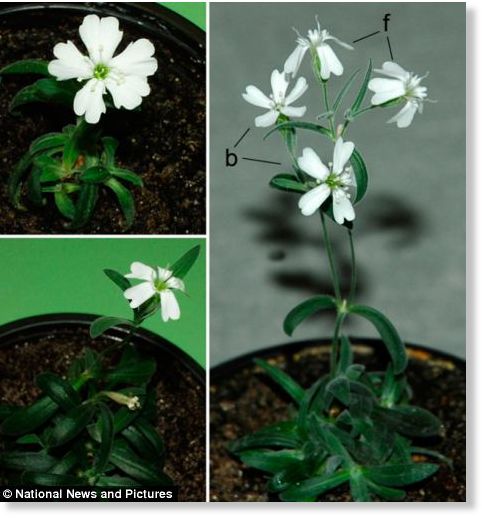
PHOTO: A prehistoric plant resurrected from frozen tissue.
A narrow-leaf campion, revived from the remains of 32,000-year-old fruit that was found buried within the fossilized burrows of ancient squirrels deep in the Siberian ice (BLOOMBERG).
MOSCOW - It was an Ice Age squirrel's treasure chamber, a burrow containing fruit and seeds that had been stuck in the Siberian permafrost for more than 30,000 years.
From the fruit tissues, a team of Russian scientists managed to resurrect an entire plant in a pioneering experiment that could pave the way to the possible resurrection of Ice Age mammals.
"If we are lucky, we can find some frozen squirrel tissue," said Dr Stanislav Gubin, one of the authors of the study.
"And this path could lead us all the way to mammoth."
PHOTO: A red squirrel curls up to protect itself from freezing day-time temperatures in Warsaw's central Lazienki Park. Fruit seeds stored away by squirrels more than 30,000 years ago and found in Siberian permafrost have been regenerated into full flowering plants by scientists in Russia, a new study revealed Tuesday. (AFP Photo/Janek Skarzynski).
The Silene stenophylla is the oldest plant ever to be regenerated, the researchers said, and it is fertile, producing white flowers and viable seeds. Canadian researchers had earlier regenerated some significantly younger plants from seeds found in burrows.
The Russian experiment proves that permafrost serves as a natural depository for ancient life forms, said the researchers, who published their findings in yesterday's issue of the United States journal Proceedings of the National Academy of Sciences.
The Russian research team recovered the fruit after investigating dozens of fossil burrows hidden in ice deposits on the right bank of the lower Kolyma River.
The sediments, dating back 30,000 to 32,000 years, were firmly cemented together and often totally filled with ice, making any water infiltration impossible - creating a natural freezing chamber fully isolated from the surface.
PHOTO: The Russian research team recovered the fruit after investigating dozens of fossil burrows hidden in ice deposits.
"The squirrels dug the frozen ground to build their burrows, which are about the size of a soccer ball, putting in hay first and then animal fur for a perfect storage chamber," said Dr Gubin, who spent years rummaging through the area for squirrel burrows. "It's a natural cryobank (A place of storage that uses very low temperatures to preserve semen or transplantable tissues)."
The burrows were located 38m below the present surface in layers containing bones of large mammals, such as mammoth, wooly rhinoceros, bison, horse and deer.
PHOTO: Woolly mammoth tusks dug up from Siberian permafrost in 1999
Japanese scientists are already searching in the same area for mammoth remains, but Dr Gubin hopes that the Russians will be the first to find some frozen animal tissue that could be used for regeneration.
"It's our land, we will try to get them first," he said.
Svetlana Yashina from the Russian Academy of Sciencesgrew the plants from immature fruits recovered from the burrow. She extracted their placentas – the structure that the seeds attach to – and bathed them in a brew of sugars, vitamins and growth factors. From these tissues, roots and shoots emerged.
Yashina potted the plants and two years later, they developed flowers. She fertilised the ancient flowers with each other’s pollen, and in a few months, they had produced their own seeds and fruits, all viable. The frozen plants, blooming again after millennia in the freezer, seeded a new generation.
PHOTO: Still growing strong: After 30,500 years buried in permanently frozen soil, the Silene stenophylla bore fruit and bloomed petite white flowers.
S.stenophylla’s resurrection shows how many treasures lie buried within the world’s permafrost. This soil, defined as that which stays below freezing for two years or more, covers a fifth of the planet’s land. It is home to bacteria, algae, fungi, plants and more. In the fossil burrows that Yashina has studied, scientists have found up to 600,000 to 800,000 seeds in individual chambers.
Update: The lead author, David Gilichinsky passed away on 18 February, just two days before his final paper was published.